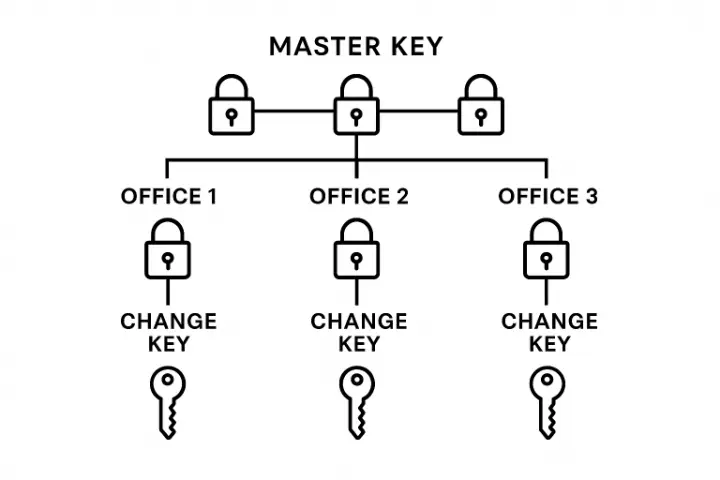


A master key system is a structured keying arrangement that allows multiple levels of access within a building or group of buildings. It enables different keys to open specific doors, while one or more master keys can open multiple (or all) doors in the system.
Key Components of a Master Key System
- Change Key (CK):
Opens only one specific lock.
Cannot open any other lock in the system.
- Master Key (MK):
Controls all the locks operated by the change keys in its system.
- Grand Master Key (GMK):
Works for all locks in multiple master key groups.
- Great Grand Master Key (GGMK):
Opens every lock in the entire system, even across several properties or buildings.
Example
Consider an office building:
- Individual offices: Each has a change key that only opens that door.
- Department heads: Have a master key that opens all office doors in their department.
- Facilities manager: Has a grand master key that opens all offices in the building.
How It Works Mechanically
In a pin tumbler lock, a master key system uses additional master wafers or pins in each chamber. These create multiple shear lines:
- One shear line aligns for the change key.
- Another shear line aligns for the master key.
Benefits
- Controlled access levels.
- Fewer keys for those who need broader access.
- Efficient for commercial, institutional, and multi-tenant properties.
Security Considerations
- More shear lines = more vulnerability to picking.
- Key control is critical; unauthorized duplication of master keys poses a serious risk.
- High-security systems (e.g. Medeco, ASSA) often incorporate patented keyways and stricter controls.
Let me know if you want a diagram or a breakdown for a specific application like a school, apartment complex, or office.